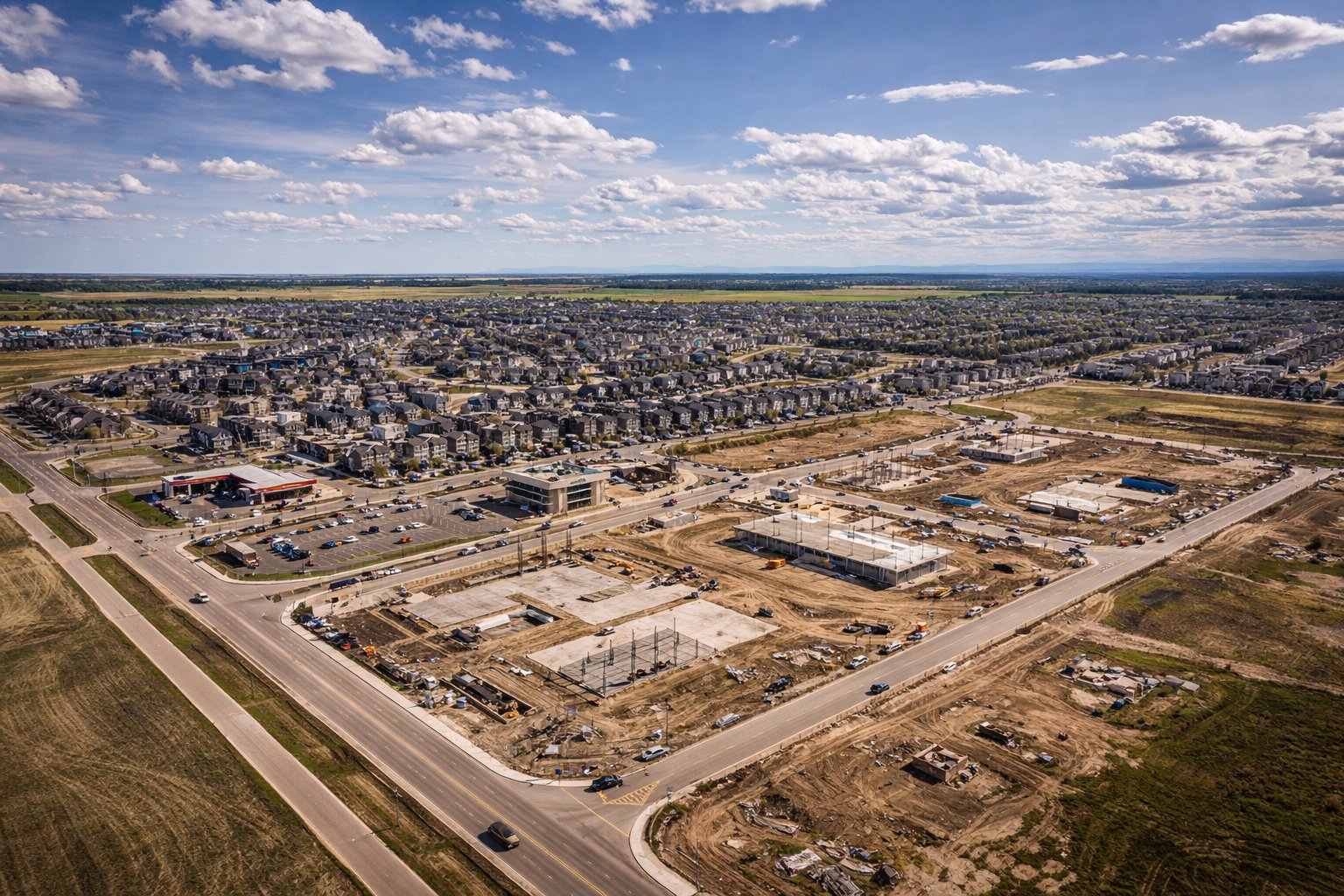
Airdrie, Cochrane, Chestermere, and Okotoks share a common trajectory: they are among the fastest-growing communities in the Calgary region, absorbing waves of new residents drawn by relative housing affordability, family-oriented neighbourhoods, and easy commuter access to the city. What they consistently lack is healthcare infrastructure that keeps pace with rooftops. For developers, clinic operators, and investors, that gap is not a problem to lament — it is a clearly defined development opportunity.
Why Satellite Communities Outrun Their Healthcare Supply
Residential growth and medical infrastructure move on very different clocks. A homebuilder can bring a new subdivision to market in a matter of quarters; a purpose-built medical facility, by contrast, depends on suitable zoned land, tenant demand of a certain density, and financing that assumes a stabilized patient base. The result is a structural lag. Families move in first, and the clinics, diagnostic services, and allied health providers follow years behind.
This lag is compounded in bedroom communities specifically because much of the early population commutes into Calgary for work. For a time, residents simply carry their healthcare relationships with them — seeing a family physician, dentist, or physiotherapist near the office rather than near home. But as these communities mature, add amenities, and attract residents who both live and work locally, demand for healthcare close to home intensifies quickly. The catch-up rarely happens smoothly, which is precisely what creates opportunity for well-positioned development.
Reading the Demand Signals Before You Build
The strongest satellite-market opportunities announce themselves through observable, ground-level signals rather than headline growth statistics. Sophisticated developers and operators watch for a convergence of indicators:
- Existing clinics that are closed to new patients or quoting long wait times for appointments
- Residents routinely driving into Calgary for routine primary, dental, or diagnostic care
- A residential pipeline of approved subdivisions and permits that signals sustained household formation
- Limited existing medical-office inventory, particularly modern, purpose-built space
- Demographic shifts toward young families and aging-in-place residents, both heavy consumers of healthcare
- Municipal planning documents that designate commercial or mixed-use nodes without a healthcare anchor yet in place
When several of these align in a single community, the case for purpose-built medical development strengthens considerably — not on speculation, but on demonstrable unmet local demand.
The Case for Purpose-Built Over Converted Space
Much of the medical care in growing satellite communities is delivered from space that was never designed for it — repurposed retail bays, second-generation office suites, or strip-plaza units retrofitted at the tenant's expense. These spaces impose real constraints: inadequate plumbing for multiple exam rooms, ceiling heights and structural loads unsuited to imaging equipment, insufficient parking for a high-turnover patient practice, and layouts that fight against efficient patient flow.
Purpose-built medical facilities solve these problems at the design stage. They offer the floor plates, servicing, accessibility, and parking ratios that healthcare tenants need, and they signal permanence to a community and its practitioners. For operators weighing where to plant a multi-decade practice, that difference is decisive. For developers and investors, purpose-built medical real estate tends to attract creditworthy tenants on longer leases, which supports both stable income and asset value.
Pre-Leasing as the Risk-Management Tool
The financial logic of clinic development in these markets rests heavily on pre-leasing. Securing anchor tenants — a primary care group, a pharmacy, a diagnostic or dental practice — before or during construction transforms the risk profile of a project. Pre-leasing validates local demand with real commitments, de-risks the construction financing conversation with lenders, and often allows the building to be tailored to the specific needs of tenants who will occupy it for the long term.
In undersupplied satellite communities, the conditions for strong pre-leasing frequently exist because demand is genuine and alternatives are scarce. Operators who have been managing with cramped or makeshift space, or who see a growing catchment with no modern facility to serve it, are motivated to commit early to secure a superior location. That motivation is the developer's advantage, provided the site, the design, and the tenant mix are matched thoughtfully to what the community actually needs.
Matching the Facility to the Community
No two of these markets are identical, and the right project reflects local conditions rather than a generic template. A community weighted toward young families may support a facility anchored by primary care, pediatrics-friendly practices, and a pharmacy, while an area with a significant aging population may justify space configured for diagnostics, rehabilitation, and allied health. Site selection matters as much as programming — proximity to residential density, visibility, accessibility, and parking all shape a facility's leasing prospects. The developers who succeed treat these as market-specific decisions grounded in local demand, not assumptions carried over from Calgary proper.
How PRAXIS Helps
PRAXIS Healthcare Real Estate works exclusively at the intersection of healthcare and commercial real estate across Alberta, helping developers, investors, and clinic operators identify undersupplied satellite markets, structure pre-leasing strategies, and match purpose-built facilities to genuine local demand. Led by Mya Qi, MPH, the practice brings a public-health lens to site selection and tenant strategy that generalist brokers rarely offer. If you are evaluating a clinic development or seeking an anchor location in Airdrie, Cochrane, Chestermere, or Okotoks, reach out to PRAXIS to start the conversation.